
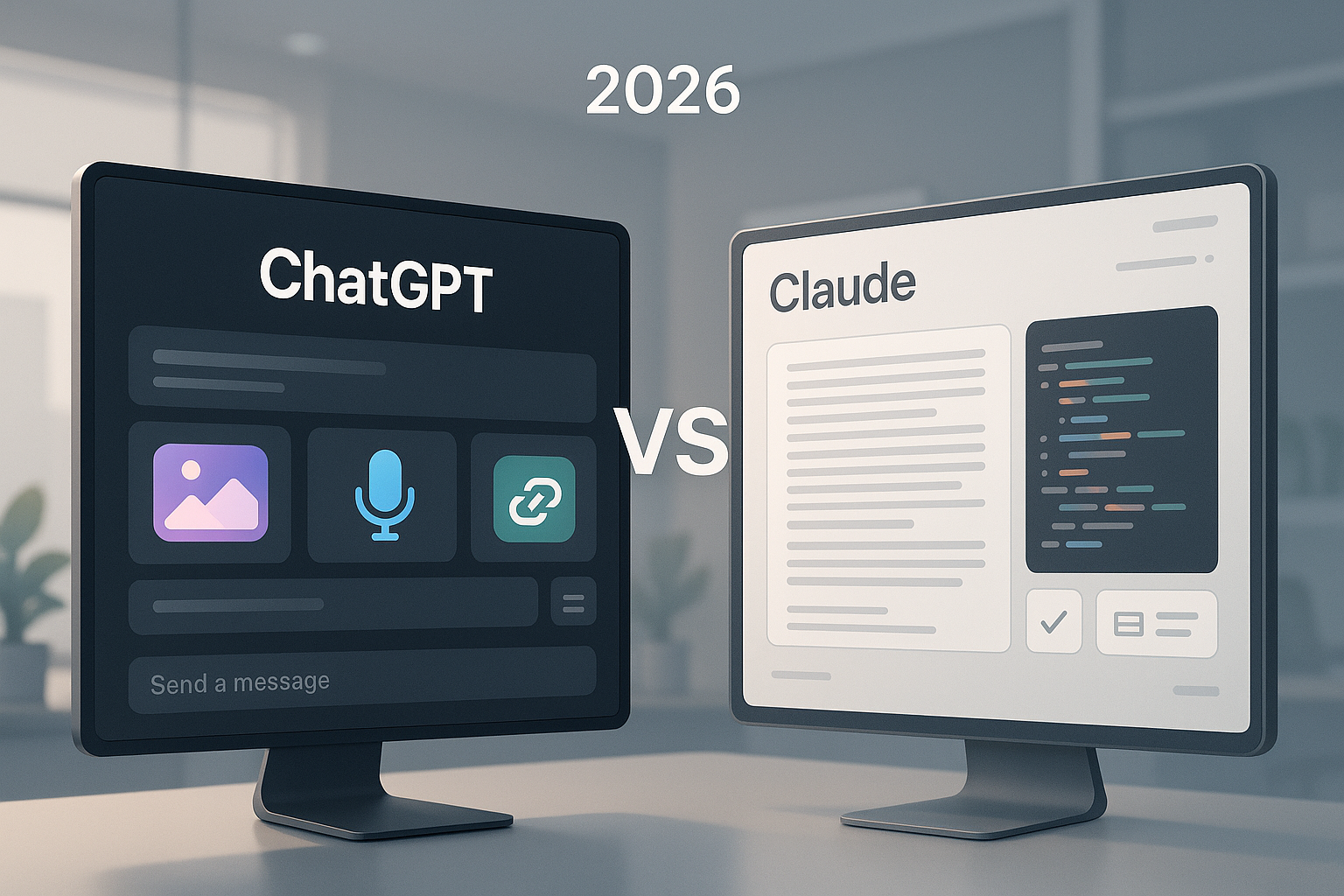
Deciding between ChatGPT from OpenAI and Claude from Anthropic in 2026 really comes down to what you prioritize. Are you after rich multimodal creativity combined with a vast ecosystem, or do you need an assistant that excels in careful reasoning and mastering long documents? This article dives into a detailed comparison of both assistants—covering features, verified pricing snapshots, practical use cases, and guidance on which tool suits various users best.
Table of Contents
Quick summary
Here’s the gist: ChatGPT shines with a wider range of multimodal features—including image generation, advanced voice capabilities, plugins, file analysis, and code execution—plus it benefits from an enormous user base. Claude, on the other hand, focuses on managing extensive contexts, delivering thoughtful reasoning, and offering productivity tools tailored for knowledge work and coding. Both assistants offer free and paid plans, with entry-level paid tiers in Australia hovering around AUD 30–35 per month as of mid-2026 (based on research snapshots). For more insights, see Tech Insider and TechTimes.
Feature comparison (side-by-side)
| Capability | ChatGPT (OpenAI) | Claude (Anthropic) |
|---|---|---|
| Flagship models (2026) | GPT-5 family; GPT-5.5 serves as the paid flagship for most users (Tech Insider) | Claude family includes Haiku (fast and affordable), Sonnet (balanced), and Opus (most powerful); Opus 4.8 launched May 28, 2026 (Tech Insider) |
| Multimodal (images & voice) | Built-in image generation and advanced voice interaction (Tech Insider) | No native image generation as of 2026; emphasis remains on text and code (Tech Insider) |
| Long-context handling | Supports high context-window settings with top tiers reaching up to around 1 million tokens (Tech Insider) | Also supports very large context windows; renowned for handling extensive long documents (Tech Insider) |
| Web browsing & connectors | Offers web browsing plus a vast plugin and app ecosystem (Tech Insider) | Provides web search and connector support, including the Model Context Protocol (Tech Insider) |
| Code tools | Includes code execution capabilities and numerous developer integrations (Tech Insider) | Features Claude Code: terminal-based tooling excelling in code review and repository-level changes (Tech Insider) |
| Document & file analysis | Integrated tools for file and document analysis (Tech Insider) | Optimized for handling long documents, managing projects, and supporting iterative workflows (Tech Insider) |
| Paid/free tiers | Free tier available; ChatGPT Plus roughly AUD 35/month in Australia (2026 snapshot, Tech Insider) | Free tier available; Claude Pro around AUD 30/month in Australia (2026 snapshot, Tech Insider) |
| Ecosystem & integrations | Extensive third-party apps and plugins (Tech Insider) | Connector-first design with productivity features like Cowork, Dispatch, and project-focused tools (Android Authority) |
Notes on the data
- Context-window capacities and feature details come from the 2026 snapshot provided by Tech Insider.
- Market share and user data are based on Sensor Tower reports summarized by TechTimes.
- Hands-on product experiences, including Claude’s Cowork, Dispatch, and Claude Code features, are drawn from an Android Authority review.
Top 10 differences (quick scan)
- Multimodal range — ChatGPT supports native image generation and advanced voice; Claude (as of 2026) centers on text and code.
- Model lineup — OpenAI offers GPT-5 and GPT-5.5; Anthropic provides Haiku, Sonnet, and Opus series (Opus 4.8 released May 2026).
- Long-document focus — Claude stands out for handling prolonged documents and complex project workflows.
- Plugin ecosystem — ChatGPT boasts a broader library of plugins and third-party apps.
- Response style and safety — Claude is known for calm, thoughtful replies and safety-first defaults.
- Code support — Claude Code specializes in repo-wide edits; ChatGPT delivers wider code execution and developer tool integrations.
- Context window size — Both offer high-end context windows of up to around 1 million tokens.
- Pricing entry — Both provide free tiers; paid entry-level plans in Australia sit near AUD 30–35/month.
- User numbers — ChatGPT leads with approximately 1.1 billion monthly users (May 2026), compared to Claude’s 245 million.
- Business automation — Claude includes Cowork, Dispatch, and project management tools suited for automation.
Pricing and market share (verified snapshots)
Keep in mind that pricing and market-share figures represent specific points in time. According to mid-2026 data:
- Entry paid tiers in Australia: ChatGPT Plus is about AUD 35/month (GST included); Claude Pro is roughly AUD 30/month (GST included). Source: Tech Insider.
- Higher-level subscriptions: ChatGPT Pro is cited at around AUD 300/month; Claude Max ranges between AUD 150–300/month (Tech Insider).
- Market share and monthly active users (Sensor Tower/TechTimes, May 2026): ChatGPT leads with 1.1 billion MAUs and 46.4% market share. Claude follows with approximately 245 million MAUs and a 10.3% share, with a paid conversion rate near 13%. Source: TechTimes.
For the most current pricing or plan details, it’s always best to check directly with the providers, as these figures can evolve.
Real-world use cases and examples
Writers and researchers
Claude is often the go-to for those working with long-form research, drafting detailed reports, or managing workflows that demand careful, iterative questioning and summarization of large contexts. Journalists and productivity experts appreciate Claude’s habit of asking clarifying questions and its prowess with lengthy documents.
Designers and content creators
ChatGPT’s native image generation and richer multimodal features make it a strong choice for quickly creating prototypes, crafting image-aware prompts, and running voice-enabled brainstorming sessions. Its extensive plugin ecosystem also benefits content teams needing smooth integration with CMS platforms, asset repositories, and publishing tools.
Developers and engineering teams
Both assistants support coding tasks, but they approach workflows differently:
- ChatGPT offers broad code execution options and numerous integrations, perfect for quick tests, snippets, and plugin-enhanced coding.
- Claude: Features Claude Code, tailored for repository-level changes and automated testing. According to Android Authority’s review, it can analyze a codebase, perform edits across multiple files, run tests, and commit code seamlessly (source: Android Authority).
Automation and background tasks
Claude’s Cowork and Dispatch tools, highlighted by Android Authority, focus on automating background tasks and coordinating execution across devices—ideal for saving time on repetitive chores across your desktop and phone.
Bundled multi‑model use
Some third-party apps offer subscriptions bundling multiple AI models. For instance, a promotional offer featured by Boing Boing bundles GPT, Claude, and other assistants under a single paid plan. Keep in mind this is promotional material, so always verify claims directly with the vendors before subscribing.
Pros and cons
ChatGPT — Pros
- Robust multimodal features including image generation, voice, browsing, and plugins (Tech Insider).
- Vast developer and third-party ecosystem.
- Massive user base coupled with frequent feature updates.
- Generous free tier for casual users (Tech Insider).
ChatGPT — Cons
- Sometimes leans towards more elaborate or “padded” prose, which some users find less concise (Tech Insider).
- Adjustments in free-tier access can frustrate intensive users, with differences in session behavior between free and paid plans.
Claude — Pros
- Exceptional at working with long documents and maintaining context over extended interactions (Tech Insider).
- Delivers calm, safety-focused responses and thoughtful reasoning (Tech Insider).
- Strong productivity tools like Cowork, Dispatch, and Claude Code are designed to enhance project workflows and automation (Android Authority).
- High-conversion rates and strong appeal among knowledge workers (TechTimes).
Claude — Cons
- Lacks native image generation as of the 2026 snapshot.
- More limited voice and multimodal options compared to ChatGPT (Tech Insider).
- Smaller user base overall compared to ChatGPT (TechTimes).
How we evaluated
This analysis draws exclusively on the verified sources listed. Our key evaluation criteria included:
- Detailed feature comparisons and product capabilities from Tech Insider’s 2026 snapshot.
- Market share, monthly active user counts, and paid conversion rates are summarized from Sensor Tower data in TechTimes.
- Firsthand product workflow observations reported by Android Authority.
- Examples of bundled multi-model offerings drawn from a promotional summary on Boing Boing.
Where data was not clearly confirmed, we avoided speculation, focusing instead on concrete, dated facts, product names, release timelines, and market figures from the cited sources.
Who should use which assistant?
Pick ChatGPT if you:
- Depend on multimodal features like native image generation and voice interaction.
- Need access to a wide variety of plugins and third-party integrations.
- Want to tap into the largest ecosystem with frequent new features.
Pick Claude if you:
- Work heavily with long documents, such as legal or scientific texts, needing strong context retention.
- Prefer an assistant who responds calmly, emphasizes safety, and asks clarifying questions.
- Value built-in productivity features—like Cowork, Dispatch, and repository-aware coding tools (Claude Code).
Affiliate recommendation (objective)
If you’re considering investing in one paid assistant to boost productivity, match your choice to your primary workflow:
- For creative teams juggling multimedia content and prototyping, ChatGPT’s multimodal capabilities and plugin ecosystem are particularly appealing. For the latest pricing, check OpenAI’s official site.
- For researchers, knowledge workers, and engineering teams focused on long-form drafting and automated code management, Claude’s specialized features like Cowork, Dispatch, and Claude Code make it a strong candidate. The Android Authority review offers a hands-on perspective worth reading.
Both companies offer free tiers—try both to see which fits your workflows best before subscribing. Remember, pricing data here represents mid-2026 snapshots reported by Tech Insider.
Final verdict
There’s no one-size-fits-all “better” AI assistant. ChatGPT leads when it comes to multimodal features, ecosystem size, and scale, while Claude shines in delivering measured reasoning, handling long documents with ease, and offering productivity automations. Many professionals find the best results by combining both: using ChatGPT for multimodal tasks and integrations and Claude for deep research, lengthy document work, and precise code modifications.
Call to action
We recommend testing both free tiers yourself. Run identical tasks—whether drafting documents, reviewing code, or generating images—through each assistant over a week. Pay close attention to output clarity, time saved, and how often you need to adjust results. This hands-on comparison will reveal which AI assistant truly fits your needs.
Frequently asked questions
1. Which assistant has more users?
According to a Sensor Tower report summarized by TechTimes, ChatGPT had about 1.1 billion monthly active users in May 2026 compared to Claude’s roughly 245 million. These numbers reflect that specific time frame.
2. Do both assistants offer free tiers?
Yes, both OpenAI and Anthropic provided free tiers to users in the 2026 snapshot (Tech Insider).
3. Which assistant is better for long documents?
Claude is widely regarded as superior for handling long documents and tasks requiring sustained context. Tech Insider highlights Claude’s strengths in long-document support and its popularity among knowledge workers.
4. Does Claude generate images?
As of 2026, Claude did not offer native image generation, according to Tech Insider. ChatGPT, by contrast, included native image generation capabilities.
5. Which assistant excels at coding?
Both perform well, but their strengths differ. ChatGPT offers broad code execution and developer integrations, ideal for quick snippets and tests. Claude’s Claude Code tool goes further, handling entire codebases, making multi-file edits, testing changes, and committing code (source: Android Authority).
6. How do the paid prices compare?
Research from Tech Insider cites entry-level paid plans in Australia around AUD 35/month for ChatGPT Plus and AUD 30/month for Claude Pro (mid-2026). Higher-tier pricing varies—always verify current prices directly with the providers.
7. Are there workarounds if a needed feature is missing from one assistant?
Absolutely. Many teams use multiple assistants or third-party apps that provide access to several models. One promotional example from Boing Boing describes an app bundling various assistants into a single subscription. Be cautious and confirm vendor details before committing.
8. How frequently do these assistants update their features?
The pace is rapid. Both companies regularly roll out new features and improvements. For the latest capabilities, consult the official vendor pages and recent hands-on reviews before finalizing your choice.
9. How reliable are these comparisons?
This article strictly uses verified data from the cited sources and avoids speculation. Since some information is snapshot-based, always check with providers directly for the most current details, particularly before making enterprise decisions.
Related articles
- Claude AI Review (2026)
- Best AI SEO Tools
- AI News
- What is the latest Powerful news about AI?
- ai news
For a deeper dive into the sources behind this comparison, see Tech Insider’s detailed ChatGPT vs. Claude overview (Tech Insider), the Sensor Tower market analysis at TechTimes, a hands-on Claude feature review from Android Authority, and a promotional multi-model bundling example discussed by Boing Boing.
If you’d like, I can prepare a tailored checklist to test both assistants on your specific workflows—whether content writing, legal drafting, software development, or marketing automation. Just let me know which area you want to focus on.