
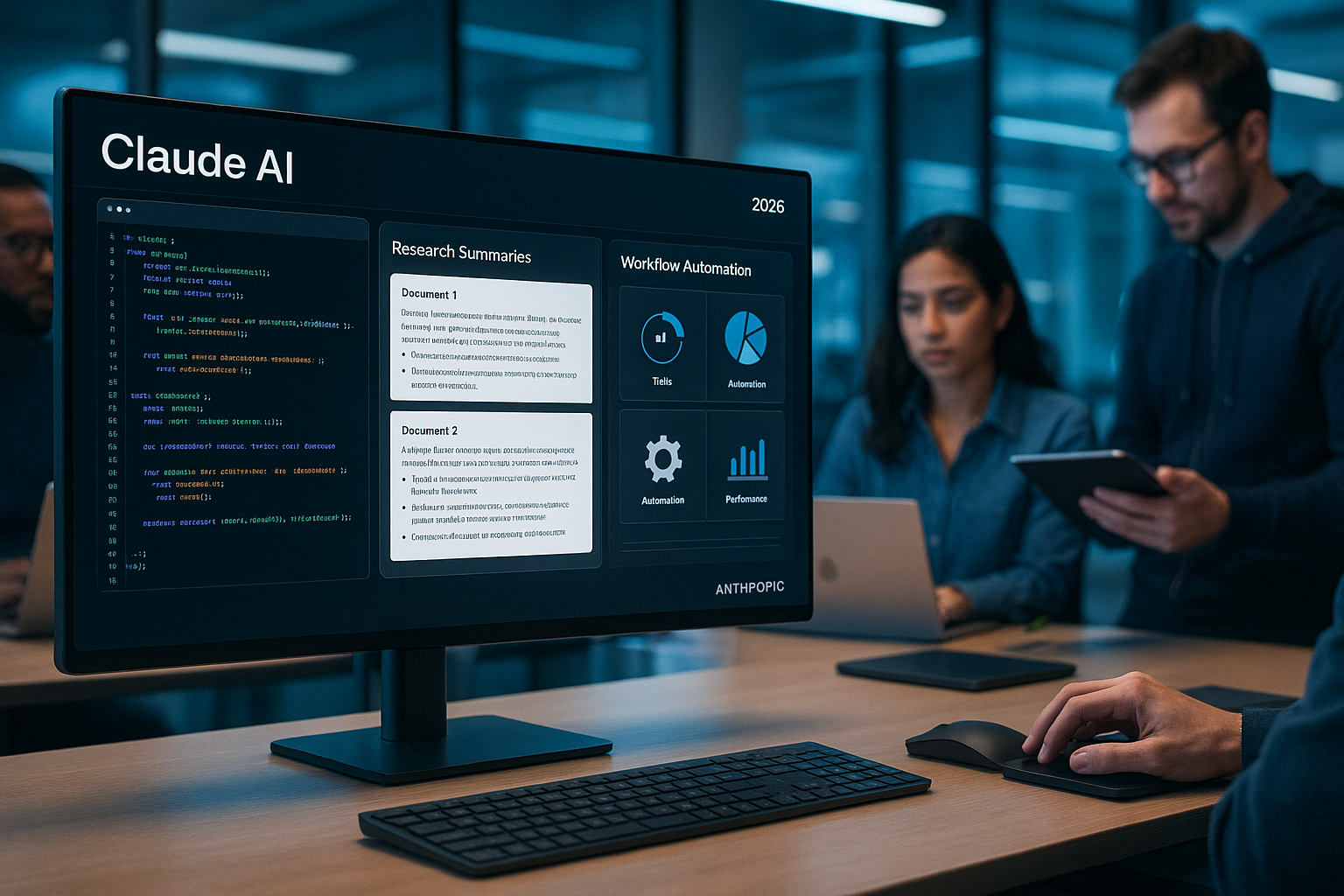
Claude by Anthropic has become one of the most talked-about AI assistants in 2026. With the launch of their latest models—Fable 5 and Mythos 5—alongside developer-centric features like Claude Code and Cowork, and a clear commitment to safety, Claude aims to meet the needs of individuals, teams, and organizations seeking a powerful, aligned AI partner. This review consolidates Anthropic’s official announcements and risk reports with independent insights from sources such as G2, MIT Technology Review, and Memeburn, offering you a clear, practical perspective to help determine if Claude fits your workflow.
Table of Contents
Quick summary
Claude is a suite of conversational and agentic AI models developed by Anthropic, designed specifically for handling extended context, complex reasoning, robust code generation, and automated workflows. In June 2026, Anthropic unveiled Claude Fable 5 and Claude Mythos 5 as its flagship models, boasting significant improvements in coding, long-term task management, vision capabilities, and life sciences research. The company has built in conservative safeguards and fallback mechanisms (notably through Opus 4.8) to minimize risky outputs. Independent reviews highlight Claude’s strong developer tooling and growing adoption but also point out challenges such as the potential for increased review workload, skill degradation, and real-world usage limits.
What is Claude?
Claude is Anthropic’s branded family of AI assistants that combines multi-turn conversational chat, agentic automation, and rich developer tools. The lineup includes several model tiers like Opus, Sonnet, and Haiku. Most recently, Anthropic announced two Mythos-class models in June 2026: Claude Fable 5 and Claude Mythos 5. According to Anthropic, the Mythos models stand above the Opus class in terms of raw capability, with varying safeguard settings tailored across different models (source: Anthropic announcement).
For direct information on these June 2026 releases, you can refer to Anthropic’s official announcement of Claude Fable 5 and Claude Mythos 5.
Anthropic — Claude Fable 5 and Claude Mythos 5 (Announcement)
Key features
- Large context windows and persistent workspace: Claude can handle very long context sessions and maintains persistent project contexts through features like Projects, Memory, and Artifacts. Third-party reports mention context windows reaching up to 200,000 tokens in some variants (G2, Memeburn), making it well-suited for analyzing multiple documents and managing extensive workflows.
- Agentic tools (Cowork, Managed Agents): Options for desktop automation and managed agents capable of carrying out multi-step tasks. Notably, these agents can \”dream\” — leave notes to themselves — to better consolidate knowledge related to specific tasks, as reported at Anthropic events and in MIT Technology Review articles.
- Developer tooling (Claude Code, Code Ultra): Integrations with terminals and IDEs that support code generation, multi-file refactoring, and assistance with large codebases. The “Code with Claude” event emphasized how these tools can automate essential engineering processes.
- Fallback safety behavior: A safety mechanism where, for sensitive topics like cybersecurity, biological or chemical assistance, or model distillation requests, classifiers redirect responses to Claude Opus 4.8 instead of generating a direct answer from Fable or Mythos models (according to Anthropic).
- Artifacts & project memory: Persistent storage of artifacts and memory to ensure continuity across sessions, while observing the privacy and data retention policies detailed by Anthropic and independent reviewers.
Feature notes and coverage
G2’s review specifically highlights the Chat, Cowork, and Code modes available in the desktop app, showcasing extended \”thinking\” modes powered by Opus models and agentic capabilities. For a more detailed breakdown of these modes and user satisfaction insights, check out G2’s overview.
G2 — My Claude AI Review (2026)
Performance & capabilities
Anthropic positions Fable 5 and Mythos 5 as state-of-the-art models across numerous benchmarks, particularly excelling in software engineering, long-horizon autonomous tasks, vision, knowledge work, and life sciences research (source: Anthropic announcement). Safety features keep the user experience consistent by falling back to Opus 4.8 when risky content is detected.
Notable performance claims (reported by Anthropic)
- Fable 5 is said to be more token-efficient based on coding benchmarks, referencing Cognition’s FrontierCode evaluations.
- Safeguards in Fable 5 trigger in fewer than 5% of sessions on average, with over 95% of sessions completing without falling back to Opus 4.8 (Anthropic data).
- Real-world examples include an internal Stripe use case where Fable 5 handled a codebase-wide migration of a 50-million-line Ruby codebase within a single day, and Mythos 5 accelerating protein design efforts roughly tenfold. These examples come directly from Anthropic and showcase vendor-provided case studies.
Independent observations
Reports from MIT Technology Review and Memeburn corroborate Claude’s strong gains, especially in developer workflows and agentic automation. However, they also reveal practical concerns such as increased code review demands and security challenges when deploying generated code (MIT Technology Review). Memeburn and G2 highlight real-world limitations like usage caps, cautious fallback responses, and the lack of robust native multimodal generation (e.g., images and videos).
MIT Technology Review — Code with Claude coverage
Memeburn — Claude AI Review 2026
Top 10 use cases for Claude
- Large-scale codebase refactors and migrations, supported by developer feedback and Anthropic’s case studies.
- Multi-document research synthesis and comprehensive literature reviews are made possible by Claude’s long context windows.
- Automation of engineering workflows through Claude Code and managed agents, streamlining complex tasks.
- Writing and editing long-form content seamlessly using persistent Projects and Memory for continuity.
- Vision-assisted tasks like document understanding and multimodal reasoning where capabilities are enabled.
- Ideation and hypothesis generation in life sciences, with Mythos 5 tailored for biological research under controlled access.
- Automating repetitive desktop tasks via Claude Cowork, currently in beta but showing promise according to reviewers.
- Complex planning and extended autonomous tasks, supported by Anthropic’s benchmark claims.
- Debugging and interactive coding within notebooks and IDEs, as demonstrated in Memeburn’s testing.
- Facilitating team collaboration through Projects and shared Artifacts, enabling ongoing coordinated work.
Pricing & availability (verified items)
Pricing for Claude varies depending on the model tier and subscription level, with details provided by Anthropic and independent sources. Here’s what’s been verified:
- Token pricing for the new Fable 5 and Mythos 5 models is $10 per million input tokens and $50 per million output tokens (based on Anthropic’s announcement).
- From launch through June 22, 2026, Fable 5 was available at no additional cost on the Pro, Max, Team, and seat-based Enterprise plans, with plans to remove this offering on June 23, 2026, subject to capacity constraints (Anthropic).
- Third-party sources like G2 and Memeburn report consumer subscription tiers with approximate prices: Free tier at $0, Pro around $17–$20 per month, Max near $100 per month, with Team and Enterprise pricing varying. Note that these are vendor-reported snapshots and may evolve; always check Anthropic’s official pricing page for the latest.
Note: Since subscription rates and quotas can change, it’s best to confirm up-to-date pricing directly with Anthropic, especially after June 23, 2026.
Security, safeguards, and data handling
Anthropic has embedded robust safeguards within Fable 5 and Mythos 5. Here are key, verifiable points from their announcements and documentation:
- Fable 5 includes enhanced conservative safeguards. Mythos 5 shares the same core model but with some safeguards relaxed for select users like cyberdefenders and infrastructure providers, deployed under Project Glasswing (Anthropic announcement).
- When safety classifiers detect queries related to sensitive areas—cybersecurity, biological/chemical topics, or model distillation—Fable 5 automatically falls back to the Claude Opus 4.8 model, and users are informed of this fallback (Anthropic).
- Mythos-class traffic logs are retained for 30 days and are typically deleted after that period. Anthropic commits that such data will not be used to train future Claude models or for any non-safety-related purposes.
- Access to Fable 5 and Mythos 5 was temporarily suspended following a U.S. government directive issued on June 12, 2026. Anthropic is actively working to restore service, indicating the interplay between regulatory constraints and operational access (Anthropic announcement).
- Anthropic conducted extensive external security testing—including over 1,000 hours of bug bounty and red-team exercises—and found no universal jailbreaks. They acknowledge that completely preventing jailbreaks may be impossible and continue ongoing monitoring and testing.
Practical security implications
For organizations, Claude’s fallback mechanism to Opus 4.8 provides continuity rather than outright refusals on risky queries—beneficial for workflow but requiring careful auditing in regulated environments. The 30-day retention policy for Mythos-class logs applies broadly, but if your organization depends on longer data retention, compliance guarantees, or custom SLAs, it’s essential to engage Anthropic’s sales or enterprise representatives directly.
Pros & cons
Pros (based on Anthropic’s statements and independent reviews)
- Top-tier performance across a range of benchmarks, including coding, vision tasks, autonomous workflows, and life-sciences applications.
- Comprehensive developer tooling and agentic features such as Claude Code, Code Ultra, Cowork, and managed agents, which can automate sophisticated engineering workflows (MIT Technology Review, Memeburn).
- Exceptional handling of large context windows and persistent project memory, enabling seamless multi-session work (G2, Memeburn).
- User-friendly fallback safety system routing sensitive queries to Opus 4.8 to maintain the user experience.
- Vendor transparency through published safeguard details, system cards, and risk reports accompanying Fable/Mythos releases (Anthropic announcement).
Cons (drawn from both Anthropic and independent critiques)
- Conservative safeguards sometimes lead to false positives, causing harmless prompts to be blocked or downgraded to the less capable Opus model (Anthropic acknowledgment).
- Mythos 5 access is limited to select partners, and general availability was paused following government directives, which may affect deployment plans (Anthropic).
- Usage limits and rate caps exist even on some paid tiers, potentially disrupting workflows (G2, Memeburn).
- The developer community has expressed concerns about the additional review workload, security implications of generated code, and possible skill erosion from over-reliance on AI (MIT Technology Review).
- Compared to some competitors, Claude currently has limited native multimodal generation capabilities—no built-in support for creating images or videos was reported (Memeburn).
How we evaluated
This review draws from Anthropic’s original announcements and risk documentation, alongside three reputable independent sources: G2, MIT Technology Review, and Memeburn. Our evaluation criteria included:
- Official vendor information such as system cards and risk disclosures.
- Independent product analyses focusing on features, user experience, and adoption.
- Community feedback from developer events highlighting practical production issues and risks.
- Verification of claimed capabilities through publicly shared case studies and explicitly stated limitations.
We did not run original benchmarks or create tests. Any quantitative data—like token pricing, fallback rates, or case-study outcomes—is credited as vendor-reported. Where data was unavailable (such as enterprise SLAs or post-June 23, 2026 quotas), we specify this and advise contacting Anthropic for clarification.
Who should use Claude?
- Software engineering teams: Those looking to automate refactors, code generation, and manage large codebases will find Claude Code and agentic tools valuable, but should implement rigorous code review and security checks as recommended by MIT Technology Review.
- Researchers and knowledge workers– professionals who need to synthesize information across multiple documents or engage in complex, long-form reasoning can benefit from Claude’s extended context and persistent project features.
- Life-sciences researchers with authorized access: Mythos 5 offers promising acceleration of protein-design workflows, though access is limited and regulated for responsible use.
- Individuals and teams seeking agentic automation: The Cowork feature and managed agents help automate desktop workflows, though reviewers note current caveats around capacity, security, and usage limits.
Affiliate recommendation (objective)
If you depend daily on capabilities like coding, multi-document research, or agentic automation, it makes sense to consider a paid plan that fits your usage and security needs. Independent reviewers such as G2 and Memeburn suggest the Pro tier as a sweet spot for many individual users, with prices around $17–20/month in their reporting; the Max tier (around $100/month) also serves power users. These are third-party price references—be sure to check Anthropic’s current pricing before buying.
Here’s a quick rundown:
- Start with the Pro plan if you want dependable access, access to Code tools, and higher limits than the Free tier. Use your first month to evaluate your actual limits and needs.
- For engineering teams or heavy agent usage, explore Team or Enterprise plans offering features like Single Sign-On (SSO), audit logging, and increased throughput—coordinate with Anthropic to confirm precise quotas and compliance elements.
- For sensitive biology or infrastructure use cases, discuss Mythos access conditions and data retention policies with Anthropic’s sales and legal teams, given the restricted access and safety protocols.
Final verdict
By 2026, Claude stands out as a powerful, safety-conscious AI assistant with noteworthy strengths in developer tooling, handling extensive context, and automating agentic desktop tasks. Anthropic’s Fable 5 and Mythos 5 mark meaningful advancements, combining capability with thoughtful safeguards and operational controls. While independent reviews back up the claimed advantages, they also highlight real-world challenges: usage caps that can interrupt work, increased review burdens for AI-generated code, and a relative lack of native multimodal generation features.
If your workflows demand advanced code automation, deep context synthesis, or agentic task management in desktop environments, Claude is definitely worth considering. Just be prepared to implement governance and review processes and understand how safety mechanisms might affect some requests. If your focus is on specialized biological or infrastructure applications, anticipate restricted access and engage directly with Anthropic.
FAQ
1. What are Claude Fable 5 and Claude Mythos 5?
On June 9, 2026, Anthropic announced Claude Fable 5 and Claude Mythos 5. Fable 5 is a Mythos-class model designed for general availability with added safeguards. Mythos 5 uses the same underlying model but has some safeguards relaxed for select trusted users (Anthropic announcement).
2. Are Fable 5 and Mythos 5 available now?
At launch, Claude Fable 5 was broadly available, while Mythos 5 was limited to Project Glasswing partners and selected researchers. Access to both models was temporarily suspended following a U.S. government directive issued on June 12, 2026. Anthropic is working to restore availability (Anthropic announcement).
3. How does Claude handle risky requests (cybersecurity, biology)?
Anthropic uses safety classifiers that, when they detect requests involving sensitive topics like cybersecurity, biological or chemical assistance, or model distillation, cause Fable 5 to fallback to Opus 4.8 for the response. Users receive notifications when this fallback happens (Anthropic announcement).
4. What are the model pricing specifics I should know?
Anthropic set token-based pricing for Fable 5 and Mythos 5 at $10 per million input tokens and $50 per million output tokens. Subscription tiers like Pro, Max, and Team have prices reported by reviewers, but these figures may vary over time—always confirm the latest pricing directly through Anthropic.
5. Does Claude support multi-file refactors and IDE integrations?
Yes. Claude Code (and the Code Ultra variant noted in reviews) integrates with terminals and IDEs, supporting multi-file refactoring and debugging. This has been showcased in Memeburn and MIT Technology Review’s developer-focused coverage.
6. How does Claude handle user data and retention?
Mythos-class usage logs are retained for 30 days and normally deleted afterward. Anthropic states that this data will not be used to train future Claude models or any purpose outside safety monitoring. For enterprise customers, contractual details about data handling should be confirmed with Anthropic sales (Anthropic announcement).
7. Are there limits I should plan for?
Reviewers like G2 and Memeburn report that strict usage limits exist on free and some paid plans. Users performing heavy workflows, especially with Cowork and agentic features, may encounter rate caps or usage resets. Planning your subscription and quota accordingly is essential for uninterrupted production use.
8. How does Claude compare to other model families?
Anthropic ranks its Mythos-class models above Opus in capability. Independent reviews emphasize Claude’s strengths in long-context reasoning, code automation, and agentic tools. A detailed, direct comparison to specific competitors would require access to current benchmarks from those vendors, which are not addressed in the cited sources.
9. Is it safe to use Claude for biological research?
Anthropic reports that Mythos 5 has helped accelerate parts of drug design and biological research, but access is controlled and limited. Use in regulated biological contexts should follow appropriate institutional review processes, responsible-use agreements, and Anthropic’s access policies.
10. Where can I read more trustworthy coverage?
For primary information, consult Anthropic’s official announcement and system card. Independent perspectives can be found in G2’s product reviews, MIT Technology Review’s developer and event reporting, and Memeburn’s hands-on evaluation (linked below).
Related articles
- Powerful Surfer SEO Review 2026
- Best AI SEO Tools
- ai news
- AI News
- What is the latest Powerful news about AI?
Sources and further reading
- Anthropic — Claude Fable 5 and Claude Mythos 5 (Announcement)
- G2 — My Claude AI Review (2026)
- MIT Technology Review — Code with Claude coverage
- Memeburn — Claude AI Review 2026
If you need assistance determining whether Claude is the right fit for your team or guidance on integrating it safely into production workflows, reach out to your vendor representative to discuss enterprise controls. Also consider collaborating with practitioner peers to pilot and refine governance strategies before committing to broad deployment.