
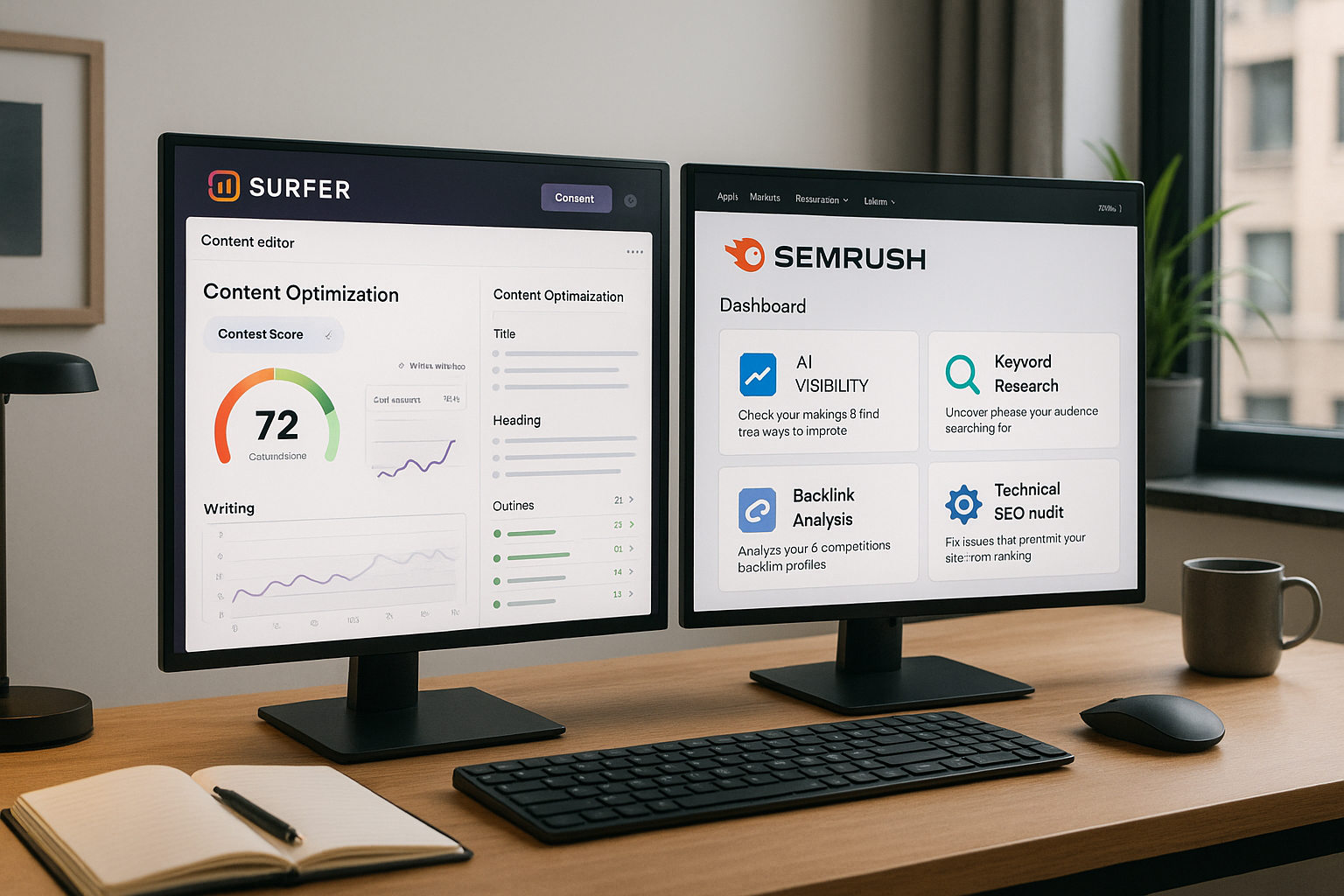
When comparing Surfer SEO and Semrush, Surfer SEO vs Semrush. It’s important to recognize they serve different purposes. Surfer SEO specializes in content and on-page optimization, while Semrush offers a comprehensive marketing and SEO suite that now includes AI visibility and large language model (LLM) monitoring. This guide will walk you through their key differences, strengths, practical applications, evaluation criteria, and clear recommendations, helping you decide which tool aligns best with your team’s needs and objectives.
Table of Contents
Overview: What each product is
Semrush (short summary)
Semrush serves as an all-in-one SEO and marketing platform, combining keyword research, backlink analysis, technical audits, PPC tools, and now an expanding set of AI visibility features. In 2026, Semrush promotes its AI Visibility Toolkit and the bundled Semrush One offering, which bridges traditional SEO signals and how brands appear in AI-generated answers. For a detailed look at Semrush’s AI capabilities, check out their blog summary on AI SEO tools.
Semrush Blog — 7 Best AI SEO Tools for 2026 (Tested Firsthand)
Surfer SEO (short summary)
Surfer SEO focuses specifically on content and on-page optimization. Its standout features include the Content Editor with a real-time Content Score, SERP Analyzer, Content Planner, and Surfer AI writing tools. Unlike platforms that emphasize backlink analysis or comprehensive technical SEO crawling, Surfer focuses on data-driven on-page guidance and content audits to help craft higher-performing pages.
DemandSage — Surfer SEO Review 2026
Head‑to‑Head Comparison
What each tool is best for
- Surfer SEO: Excels at on-page content optimization, streamlined editorial workflows, content audits, and planning content clusters. Ideal for content teams and agencies aiming for faster, SERP-driven drafting and editing processes.
- Semrush offers a full marketing stack including keyword research, competitor insights, backlink analysis, technical audits, PPC research, and AI/LLM visibility tracking. Best suited for teams that require an end-to-end SEO solution incorporating paid search and brand visibility within AI-powered answers.
AI & LLM visibility
Semrush has built dedicated AI visibility tools. The AI Visibility Toolkit and Semrush One bundle enable prompt tracking and gauge a brand’s footprint within AI-generated answers. Semrush boasts a database of over 239 million AI search prompts from eight regions and tracks these daily, connecting AI mentions back to traditional SEO signals like backlinks and site structure.
Semrush Blog — AI Visibility details
While Surfer has incorporated some LLM-aware features such as Surfer AI, Content Score, and Auto-optimize to better align content with SERP intent, its main focus remains on on-page content metrics rather than cross-platform AI mention tracking. DemandSage offers an in-depth look at Surfer’s Content Score and Surfer AI capabilities.
Content optimization & workflow
- Surfer: Features a real-time Content Score ranging from 0 to 100, a Content Editor providing live recommendations, a Content Planner, plus integrated AI generation through Surfer AI. DemandSage highlights the seamless integration with Google Docs and WordPress, streamlining the editing and publishing processes.
- Semrush: Comes with content optimization tools embedded in its Content Toolkit, linked with broader SEO signals. Semrush supports content briefs, topic research, and links AI visibility data back into overall content strategy as outlined in their blog and by Search Atlas.
Technical SEO and site crawling
Semrush includes site auditing and technical SEO tools within its all-in-one platform. While there are specialized technical crawlers such as Screaming Frog for deep site analysis, Semrush shines at prioritizing SEO issues across complex sites within a unified system. Surfer offers content auditing but does not provide a full technical crawling feature.
Search Atlas — SEO tool types and context
Integrations & automation
- Semrush supports a broad array of integrations and offers extended toolkits for marketing workflows, consolidating SEO and AI visibility signals through the Semrush One bundle.
- Surfer prioritizes writer-friendly integrations—Google Docs and WordPress are key connectors that ease editing and publishing tasks.
- For organizations needing advanced automation or large-scale workflow refreshes, other platforms like Search Atlas or AirOps, often mentioned alongside Semrush, may complement either tool depending on your specific requirements.
Quick Comparison Table
| Area | Semrush | Surfer SEO |
|---|---|---|
| Primary focus | All‑in‑one SEO + marketing + AI visibility tracking | On‑page content optimization and content workflows |
| AI / LLM features | AI Visibility Toolkit, prompt tracking, Semrush One bundle (AI + SEO) | Surfer AI, Auto‑optimize, Content Score (on‑page focus) |
| Typical users | Enterprise and midsize marketing teams, agencies needing full stack | Content teams, SEO specialists focused on on‑page performance |
| Notable integrations | Broad SEO + PPC + reporting integrations across toolsets | Google Docs, WordPress (writer workflow integrations) |
| Pros (summary) | Large dataset, AI visibility, end‑to‑end SEO features | Actionable on‑page recommendations, writer‑friendly editor |
| Cons (summary) | Cost and complexity: add‑ons increase price | Limited backlink/technical features; AI output needs editing |
Real‑World Use Cases and Examples
Use case: Small content team optimizing editorial output
For teams prioritizing a steady stream of quality articles that maintain on-page relevance, Surfer’s Content Editor and Content Planner streamline the drafting, scoring, and auditing process. DemandSage points out how Surfer’s editor, Content Score, and its integrations with Google Docs and WordPress improve workflow efficiency.
Use case: Enterprise brand tracking presence inside AI answers
If your goal is to track how frequently your brand appears in AI-generated answers—and understand how that visibility correlates with backlinks and site authority—Semrush’s AI Visibility Toolkit and Semrush One bundle are designed for you. They offer prompt-level tracking, Brand Performance dashboards, and connections back to traditional web signals. Semrush documents this prompt tracking with a dedicated AI search database powering the toolkit.
Use case: Agency performing full campaigns
Agencies managing integrated SEO, PPC, and content initiatives benefit greatly from Semrush’s comprehensive feature set, which includes keyword insights, backlink analysis, ad research, and AI visibility. On the other hand, specialized content-focused agencies or freelance writers might combine Surfer for content optimization with a backlink tool like Ahrefs or even Semrush to address the broader SEO picture. Several industry overviews highlight that professionals often pair tools to cover end-to-end workflows effectively.
Search Atlas — tool categories and pairing
Pricing (what research reports)
Pricing tends to change over time, so treat the following figures as snapshot examples from the research sources rather than definitive current prices. Always verify directly on vendor sites before making a purchase.
- Semrush: According to their blog, the AI Visibility Toolkit and Semrush One bundle feature prominently. Semrush One was noted to start around $199/month during previews, while the AI Visibility Toolkit appears as an add-on, reportedly around $99/month per domain in some sources.
- Surfer SEO: DemandSage lists pricing tiers such as Essential at $99/month and Scale at $219/month, along with a 7-day money-back guarantee and Surfer AI credit packages. Some variation in published pricing exists, so always confirm with Surfer.
Sources:
- Semrush Blog — 7 Best AI SEO Tools for 2026 (Tested Firsthand)
- DemandSage — Surfer SEO Review 2026
- Search Atlas — 18 Best SEO Tools in 2026
How We Evaluated
- We examined primary research sources including vendor blogs, third-party reviews, and industry summaries focusing on product descriptions, feature sets, and vendor positioning (notably Semrush blogs, DemandSage’s Surfer review, and Search Atlas analyses).
- Features were mapped against core workflows such as content optimization, AI/LLM visibility, technical audits, backlink intelligence, and integrations.
- We prioritized information published by vendors and respected third parties over anecdotal claims.
- Whenever pricing or features conflicted between sources, we flagged discrepancies and directly cited the original source rather than trying to reconcile differences ourselves.
Who Should Use This
- Choose Surfer SEO if your main focus is on-page content optimization with a writer-friendly editor and live scoring. It works best when paired with a separate backlink or technical SEO tool as needed. (See DemandSage’s overview for Surfer’s strengths.)
- Choose Semrush if you require a comprehensive platform covering keyword research, backlinks, technical audits, PPC campaigns, and AI/LLM-based brand visibility tracking. (For more, see Semrush’s blog on AI visibility.)
- Combine tools when you want Surfer’s specialized content scoring and editorial workflows alongside Semrush’s enterprise-grade backlink analysis and AI monitoring.
Affiliate recommendation (objective and transparent)
It’s important to be upfront about affiliate relationships: both Surfer and Semrush are reputable products catering to different needs. If your goal centers on accelerating content production and optimizing the writing process, Surfer is often the quickest route to consistently high-quality drafts. Conversely, if you require a broader platform for enterprise SEO, cross-channel marketing, and brand monitoring within AI-powered search answers, Semrush provides a richer dataset and extensive AI visibility features.
Always confirm the latest trial or refund policies directly with the vendor. DemandSage notes Surfer’s 7-day money-back guarantee, while Semrush offers various trial and bundle options detailed in its blog. Testing with a free trial or refund window before committing long-term is highly recommended.
Final Verdict
Rather than being rivals, Surfer SEO and Semrush complement each other. Surfer is a focused, fast, and practical tool centered around writers and on-page signals. Semrush, by contrast, is a broad, data-rich platform increasingly geared toward measuring brand visibility across AI ecosystems. If speeding up content optimization is a priority, Surfer is the go-to. But for an all-encompassing suite that includes AI visibility tracking plus SEO and PPC analytics across channels, Semrush stands out. Many teams find the best results by combining Surfer’s specialist features with Semrush’s comprehensive platform, balancing budgets and workflows to suit their needs.
Frequently Asked Questions (FAQ)
1. Which is better for content writers: Surfer or Semrush?
Surfer is tailored specifically for writers and editors. Its real-time Content Editor, Content Score, and integrations with Google Docs and WordPress make drafting and publishing smoother. DemandSage highlights these writer-centric features. Semrush offers useful content briefs and topic research, but is less focused on the writing experience.
2. Which tool gives better insights about AI/LLM visibility?
Semrush leads this area with its explicit AI Visibility Toolkit and the Semrush One bundle. It tracks AI search prompts extensively, providing valuable monitoring of how brands appear within AI-generated content. You can find more details on Semrush’s blog.
Semrush Blog — AI Visibility Toolkit
3. Can Surfer replace Semrush for an in-house SEO program?
No. While Surfer excels at on-page content optimization, it lacks comprehensive backlink intelligence, in-depth technical crawling, and the broad marketing tools that Semrush offers. Organizations requiring end-to-end SEO and advertising capabilities should opt for Semrush or pair Surfer with additional tools.
Search Atlas — tool categories
4. Does Surfer provide a Content Score, and how is it used?
Yes. Surfer’s Content Score is a 0–100 metric based on analyzing current top-ranking pages. DemandSage notes that a score around 67 or higher is often considered optimal. It serves as a comparative gauge for on-page alignment but shouldn’t be taken as a guaranteed ranking predictor.
DemandSage — Content Score details
5. How much does Semrush’s AI Visibility or Semrush One cost?
Research indicates Semrush One may start at $199/month, with the AI Visibility Toolkit as a separate add-on—figures vary by region and plan. Check the latest pricing on Semrush’s website before purchasing.
Semrush Blog — product bundle overview
6. Are Surfer’s AI outputs safe to publish as-is?
No. Multiple sources emphasize that AI-generated content requires human review and editorial refinement. Surfer’s documentation and third-party reviews advise treating AI drafts as starting points, ensuring final copy is well-edited and “humanized.”
DemandSage — Surfer AI guidance
7. Should I use both tools together?
For many teams, combining these tools makes sense. Use Surfer for its easy-to-use writer workflows and on-page optimization, while Semrush handles backlink research, technical audits, and AI-level brand monitoring. Industry reviews frequently recommend pairing specialized content tools like Surfer with broad SEO platforms such as Semrush, depending on budget and scope.
Search Atlas — pairing tools by use case
8. Will either tool replace the need for manual SEO expertise?
No. These tools speed up analysis and provide recommendations, but human strategists, editors, and technical experts remain essential. Research consistently underscores that AI-generated content and automated suggestions require careful human oversight.
Related Articles
- Best AI SEO Tools
- How to grow 5 AI social media tools tips
- What is the latest Powerful news about AI?
- ai news
- claude ai
If you’d like, I can: (1) create a detailed side-by-side migration and workflow plan for using Semrush and Surfer together on a 3-person content team; (2) draft a content brief template prefilled with Surfer Content Score targets; or (3) summarize Semrush One’s AI Visibility features and walk you through setting up prompt tracking for brand monitoring. Which option would you prefer?