
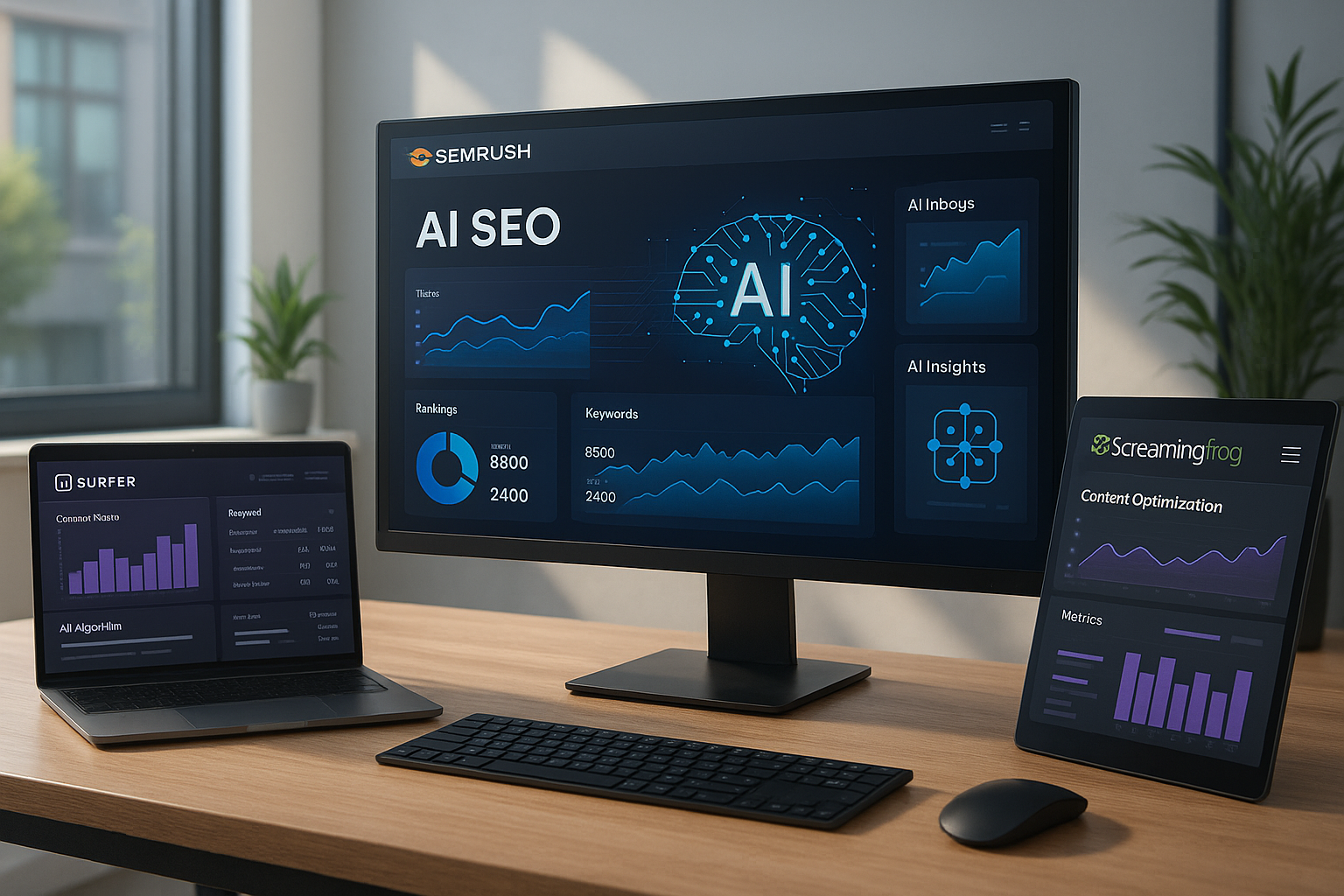
AI has fundamentally transformed how SEO teams approach keyword research, content optimization, brand presence tracking in conversational search, and automating technical fixes. This comprehensive guide explores the best AI SEO tools available in 2026, highlighting practical use cases, comparing their strengths and limitations, and offering actionable advice to help you assemble the ideal toolkit for your specific needs.
Table of Contents
Why AI SEO Tools Matter (and what they actually do)
The term “AI SEO tools” covers platforms that leverage machine learning, large language models (LLMs), and structured data sets to enhance SEO workflows. These tools support keyword research, content briefs and drafting, on-page optimization, technical audits, rank and AI-visibility tracking, and automating repetitive tasks. According to SitePoint, AI SEO tools automate keyword research, content creation, competitor analysis, and technical audits, while other sources stress their unique capability to track brand visibility within LLM-powered search results.
In essence, today’s AI SEO tools accelerate research and experimentation, uncover content gaps at scale, and bridge traditional SEO signals with emerging discovery surfaces like ChatGPT, Gemini, Perplexity, and Google AI Overviews. However, AI-generated outputs are not a substitute for human editorial judgments; they require careful verification. The ecosystem is still evolving, and no single tool offers a complete view across all AI models.
Top 10 AI SEO Tools (shortlist)
- Semrush (AI Visibility Toolkit & Semrush One)
- Surfer SEO
- SparkToro
- Screaming Frog SEO Spider
- AirOps
- AlsoAsked
- Triple Whale
- Frase
- MarketMuse
- SE Ranking
This shortlist results from extensive industry cross-coverage, drawing insights from Semrush, SitePoint, Triple Whale, ProgrammingInsider, and others. In the following section, we break down each tool’s core advantages, real-world applications, and potential drawbacks.
Tool deep dives: features, pros & cons, and use cases
1. Semrush (AI Visibility Toolkit & Semrush One)
Why it stands out: Semrush blends traditional SEO analytics with innovative AI search monitoring. Its AI Visibility Toolkit tracks how frequently your brand shows up in AI-generated answers, providing an AI Visibility Score and detailed Brand Performance reports. The Semrush One package layers this AI visibility onto a comprehensive SEO toolkit.
Sources: Semrush – 7 Best AI SEO Tools for 2026 (Tested Firsthand) and HardwareSecrets.
- Pros:
- Combines insights from AI visibility metrics with core SEO workflows such as keyword research, backlink analysis, and content optimization.
- AI Visibility Score and Brand Performance Reports connect AI mentions with traditional web signals, offering an integrated view.
- Cons:
- The AI Visibility Toolkit is an add-on that adds to the cost and can feel complex for newcomers.
- Maximizing the platform’s potential requires time to understand the user interface and select meaningful prompts to track.
- Real-world use case: Monitor a product launch across various LLMs to identify instances where competitors appear in AI answers but your brand doesn’t. Use these insights to prioritize content updates or structured data improvements that influence AI-generated summaries.
2. Surfer SEO
Why it stands out: Surfer SEO specializes in NLP-driven on-page optimization. It analyzes the top-ranking pages for your target keywords and provides a Content Score along with prescriptive recommendations aimed at improving topical coverage. Its editor and Auto-optimize feature make iterative content enhancements quicker.
Sources: Semrush blog and SitePoint.
- Pros:
- SERP-driven insights with clear content scoring that aligns with topical requirements.
- Auto-optimize streamlines on-page updates for faster turnaround.
- Cons:
- No fully free trial is offered, only a 7-day money-back window on some plans.
- AI-generated suggestions still need editorial oversight to ensure accuracy and voice.
- Real-world use case: Use Surfer’s content editor to refresh underperforming blog posts by mirroring the topical coverage of high-ranking competitors, then iterate until the Content Score improves before republishing.
3. SparkToro
Why it stands out: SparkToro is an audience intelligence platform that sheds light on where your target audience spends time online and what they’re interested in. It’s invaluable for aligning your content strategy with audience preferences and discovering the best channels for distribution that impact AI training signals.
Sources: Semrush blog and SitePoint.
- Pros:
- Reveals platform affinities and topic saturation, helping you prioritize where to distribute content and focus link-building efforts.
- Cons:
- The free tier limits the number of searches, and higher volumes require a paid subscription.
- Real-world use case: Find niche forums, podcasts, or subreddits where experts in your field gather, and target those channels for outreach that can build high-quality citations influencing AI-generated answers.
4. Screaming Frog SEO Spider
Why it stands out: Screaming Frog remains an industry-standard desktop crawler for comprehensive technical site audits, identifying broken links, missing tags, and structured data issues. Its recent integration with AI APIs allows automating tasks like generating image alt text, while its core strength is in deep technical crawling.
Source: Semrush blog.
- Pros:
- Robust crawling capabilities with detailed reporting and data visualization.
- Cons:
- The free version is capped at 500 URLs, and some AI-powered features require API keys or paid plans.
- Real-world use case: Conduct a full site crawl to locate orphaned or thin content pages, export those findings, then batch-generate content briefs via API calls—reviewing them manually before bulk content updates.
5. AirOps
Why it stands out: AirOps automates complex SEO workflows, combining content extraction, AI visibility analysis, refresh suggestions, and publishing into one streamlined process. It integrates visibility tracking with executable workflows and maintains a knowledge base to provide AI with essential product or context information.
Sources: Semrush blog and Triple Whale.
- Pros:
- Supports end-to-end automation from insight generation to execution;
- Includes a free-to-start option, making it accessible for smaller teams.
- Cons:
- The user interface and workflow setup have a learning curve, and some advanced enterprise features require paid plans.
- Real-world use case: Set up a recurring workflow to identify pages with declining AI visibility each month, generate update drafts automatically, and prepare CMS-ready content for final editorial review.
6. Also Asked
Why it stands out: AlsoAsked excels at extracting “People Also Ask” (PAA) questions and visualizing them in branching maps. This is especially helpful for planning topical clusters, FAQ pages, and developing in-depth content outlines.
Source: Semrush blog.
- Pros:
- Provides clear, hierarchical visualizations of question relationships, revealing dozens of related queries for effective topic clustering.
- Cons:
- More extensive searches require paid credits, which can become costly for larger-scale research.
- Real-world use case: Leverage AlsoAsked to build a comprehensive FAQ hub around a product category, then incorporate PAA questions as structured H2/H3 headers within pillar content.
7. Triple Whale (AI Search Analytics for e-commerce)
Why it stands out: Triple Whale focuses on connecting AI visibility directly to ecommerce outcomes. It tracks brand and product mentions across LLM responses and links AI-driven referral traffic to actual revenue and attribution, provided merchants deploy its tracking pixel and surveys.
Source: Triple Whale.
- Pros:
- Combines AI brand visibility with ecommerce attribution and paid media insights to measure revenue driven by LLM referrals.
- Offers a free plan with core AI visibility features available at no cost.
- Cons:
- Its AI visibility tools are still maturing and might not fully replace specialized enterprise platforms for in-depth reporting.
- Real-world data point: In Q4 2025, merchants using Triple Whale reported a significant increase in orders attributed to LLM referrals compared to 2024, highlighting the growing revenue potential of AI-driven discovery when accurately tracked.
8. Frase
Why it stands out: Frase excels in SERP research and quickly transforms search results into content briefs and multi-query documents. It’s widely used to streamline research-to-brief workflows for content teams.
Sources: ProgrammingInsider and Cybernews.
- Pros:
- Accelerates briefing and research processes, providing structured content outlines based on SERP data.
- Cons:
- AI-generated drafts require careful editorial review and fact-checking, and the platform may lack some advanced enterprise features.
- Real-world use case: Produce a content brief for a topical cluster that blends PAA insights with patterns from top-ranking pages, then deliver this to writers along with Frase’s detailed research notes.
9. MarketMuse
Why it stands out: MarketMuse shines at high-level content strategy and topic modeling. It helps map content clusters and identify topical gaps across a website, making it invaluable for strategic editorial planning.
Sources: ProgrammingInsider and various industry roundups.
- Pros:
- Offers robust support for strategic planning across extensive content inventories, ideal for enterprise editorial calendars and content gap analysis.
- Cons:
- Focuses on strategic overview rather than one-off content drafting or direct CMS integrations.
- Real-world use case: Employ MarketMuse to prioritize content development for expanding product lines by mapping topical clusters and internal/external linking strategies.
10. SE Ranking
Why it stands out: SE Ranking is a comprehensive SEO platform featuring rank tracking, reporting, and AI-powered capabilities like AI Writer and AI-driven forecasting. It’s an excellent fit for small to medium-sized teams needing essential SEO tools enhanced with AI.
Sources: SitePoint and Cybernews.
- Pros:
- Offers a full suite of SEO features with incremental AI enhancements tailor-made for smaller teams.
- Cons:
- Some advanced AI functionalities are locked behind higher-tier plans or add-ons.
- Real-world use case: Use SE Ranking to track keyword positions and on-page SEO, leaning on AI Writer for rapid draft creation followed by human editing before publishing.
Pricing snapshot (verified pricing)
Below is a breakdown of starting prices or example tiers reported in primary sources. If pricing could not be confirmed, it has been excluded for accuracy.
| Tool | Verified starting price/note | Source |
|---|---|---|
| Semrush (AI Visibility Toolkit / Semrush One) | AI Visibility Toolkit starts at $99/month per domain (add-on). Semrush One begins at $199/month (Starter). Higher tiers include Pro+ at $299 and Advanced at $549. | Semrush blog |
| Surfer SEO | Plans include Essential at $99/month and Scale at $219/month (ranges reported in sources). | SitePoint |
| SparkToro | Personal tier $50/month, Business $150/month, Agency $300/month; free basic plan with limited searches. | Semrush blog |
| AlsoAsked | Free basic plan (3 credits/day); paid plans start at $15/month (Basic), $29/month (Lite), and $59/month (Pro). | Semrush blog |
| Screaming Frog SEO Spider | Free limited crawl up to 500 URLs; paid license costs approximately $279 per year. | Semrush blog |
| AirOps | Free Solo plan available; Scale and Enterprise plans are custom priced with a 14-day trial for Scale. | Semrush blog |
| SE Ranking (annual examples) | SitePoint mentions tiers starting at $65 annually (as an example). | SitePoint |
If you’d like a detailed pricing comparison including additional tools, please specify which platforms interest you. I can then create a verified pricing matrix with sources from original documents.
How we evaluated these tools
Our evaluation framework draws from developer-centric roundups and industry reviews, centering around these key criteria:
- How well the tool covers AI discovery surfaces (like LLMs, Google AI Overviews, Perplexity) and measures brand visibility.
- Integration with classic SEO workflows such as keyword research, backlink analysis, and site audits.
- Depth of automation—whether it supports the entire research-to-publish cycle or just assists specific tasks.
- Transparency—can you trace AI mentions back to search signals and original data sources?
- Ease of use and cost-effectiveness relative to the intended user type: solo marketers, in-house teams, agencies, or enterprises.
- Reported limitations include additional add-on costs, learning curves, and the necessity of human editorial review.
Our sources included Semrush’s firsthand testing, SitePoint’s detailed roundup, ProgrammingInsider reviews, Triple Whale’s analyses, and other industry coverage referenced throughout this guide.
Who should use which tools?
- Large brands and enterprises focused on AI narrative monitoring: Semrush’s AI Visibility Toolkit or Profound/Peec.ai for tracking brand presence and analyzing AI narratives.
- Content teams prioritizing on-page performance: Surfer SEO and Frase for SERP-driven content briefs and scoring.
- Technical SEO and site health specialists: Screaming Frog for deep site crawls and technical problem resolution.
- E-commerce teams linking AI visibility to revenue: Triple Whale for attribution and revenue insights tied to AI-driven referral traffic.
- Small teams or freelancers needing an all-in-one solution with AI features: SE Ranking or AirOps (both offer free-start plans).
- Audience researchers and content distributors: SparkToro to discover where your audience is active online.
Affiliate recommendation guidance (objective)
When participating in affiliate programs, it’s essential to be transparent and align your recommendations with the reader’s needs. Consider:
- Suggesting Semrush’s AI Visibility Toolkit for brands eager to measure their presence in LLMs, but clearly stating the additional cost and complexity involved.
- Recommending Surfer SEO for editorial teams ready to leverage Content Score for optimizing pages, emphasizing the need for editors to validate AI recommendations.
- Recommending Triple Whale to ecommerce teams equipped to implement tracking pixels and emphasize AI-driven revenue attribution.
Always encourage testing tools on smaller projects, comparing outputs against expert judgment, and clearly disclosing any affiliate relationships in your content.
Final verdict
AI SEO tools have become integral to modern SEO strategies, but no single solution fits every need. Select tools that address the challenges you’re facing:
- If your main focus is tracking and influencing brand narratives within LLMs, look to Semrush’s AI Visibility products and Triple Whale’s commerce-integrated visibility tools—both are market leaders.
- For content optimization and expediting editorial workflows, Surfer SEO, Frase, and MarketMuse offer mature solutions that help refine topical strategy and content quality.
- For technical SEO and detailed site health checks, Screaming Frog remains a trustworthy and irreplaceable tool that pairs well with AI-driven content and visibility platforms.
Combining different tools can fill gaps effectively: use audience insights from SparkToro, content briefs from Frase or MarketMuse, optimization from Surfer, and visibility tracking from Semrush or Triple Whale. This integrated approach helps close the loop between your content and its discoverability in conversational search environments.
Next steps — a short checklist
- Clarify your top priority: is it AI visibility, accelerating content production, maintaining technical SEO health, or ecommerce revenue attribution?
- Choose one visibility-focused tool (Semrush or Triple Whale) and one content tool (Surfer or Frase), while keeping Screaming Frog handy for technical audits.
- Run a 30–60-day pilot project to evaluate how tool recommendations compare against human-reviewed decisions.
- Track results carefully—monitor organic traffic, ranking improvements, and if applicable, revenue linked to AI-driven referrals.
FAQ
1. What exactly is an AI SEO tool?
Answer: AI SEO tools use machine learning and large language models to assist with key SEO tasks: keyword research, content briefs and drafting, on-page optimization, technical audits, rank tracking, AI-visibility monitoring, and automation of routine workflows. Industry leaders like SitePoint characterize them as software that automates these functions to help teams scale and expedite optimization efforts.
2. Will AI SEO tools replace SEO professionals?
Answer: Not at all. While AI tools expedite data gathering and offer suggestions, human expertise remains vital for strategic decisions, editorial judgment, fact-checking, quality control, and more nuanced activities such as influencer outreach and partnership management. Multiple reviews highlight the importance of human oversight to ensure accuracy and maintain brand voice.
3. Can AI SEO tools influence how my brand appears in ChatGPT, Gemini, or Google AI Overviews?
Answer: Yes, but indirectly. Platforms like Semrush and Triple Whale monitor where your brand appears in LLM outputs, helping identify gaps you can address. Influencing AI summaries typically involves improving high-quality sources—such as adding structured data, building authoritative content, and ensuring consistent citations—and distributing that content effectively so LLMs encounter strong, reliable signals tied to your domain.
4. Are AI visibility metrics reliable?
Answer: They serve as directional indicators rather than exact measurements. Different AI visibility platforms sample various prompts and models, and results can fluctuate with prompt phrasing or model updates. Use these metrics to spot trends and potential blind spots rather than as definitive data points.
5. Which tools are best for ecommerce brands focused on revenue attribution?
Answer: Triple Whale specializes in e-commerce scenarios by combining AI visibility with attribution data and paid media analytics. It connects LLM referral traffic to actual orders when merchants implement its tracking tools. That said, it’s critical to assess and understand its attribution model before relying on it for budgeting decisions.
6. How should I combine tools for a balanced workflow?
Answer: A strong, balanced stack typically includes:
- Visibility tracking: Semrush (AI Visibility Toolkit) or Triple Whale
- Content optimization: Surfer SEO or Frase
- Technical audits: Screaming Frog
- Audience research & distribution: SparkToro
- Automation & execution: AirOps
Combine insights, focus on impact, match editorial capacity, and run small pilots before scaling automation workflows.
7. Has Google issued guidance about using third-party SEO tools and AI?
Answer: Google has clarified that it considers itself the primary authority on SEO best practices and cautions that third-party tools do not have access to Google’s internal ranking data. They recommend users take third-party predictions with a grain of salt and rely more heavily on first-party data sources like Google Search Console for definitive performance insights. For more, see coverage at Search Engine Journal.
8. How many prompts or checks should I track for AI visibility?
Answer: There’s no one-size-fits-all number. Semrush’s Starter tier references tracking about 50 prompts daily, while some other tools or starter plans follow a more conservative approach. The best strategy is to begin with high-intent prompts—combinations of brand, product, and common questions—monitor results, and then gradually expand your coverage based on emerging insights.
Related Articles
- How to grow 5 AI social media tools tips
- What is the latest Powerful news about AI?
- ai news
- ai news
- claude ai
If you’d like, I can create a custom comparison matrix detailing features versus use cases for any combination of these tools. Alternatively, I can help design a 30–60-day pilot plan tailored to your team’s resources and KPIs. Let me know which tools or goals you want to explore first.